

Read the job description closely and you can call the outcome before the role is even filled.
It asks for someone to build scalable growth infrastructure in HubSpot: automation, lead scoring, routing, reporting. Two sentences later it asks that same person to launch campaigns, generate qualified pipeline, and own a number. Build the engine and drive the car, at the same time, as the company’s first dedicated growth hire, with nothing waiting on day one but a login and a quota.
I have watched this play out enough times to know the shape of month three. The hire is still inside HubSpot, wiring lifecycle stages and arguing with Sales about what counts as a qualified lead. There is no pipeline yet, because there is no system yet. Leadership starts to wonder, quietly, whether they hired the wrong person.
They didn’t. They sequenced wrong. And that mistake has a name: time to pipeline.
The real cost is time to pipeline
When one person has to build the system and produce pipeline from it, those two jobs don’t run in parallel. They run in sequence. A demand gen hire takes three to six months to reach full productivity even on a clean runway. Hand them an empty one and the clock starts later still, because before they can run anything they have to build the thing that makes running possible: an ICP that Sales and marketing actually share, a CRM with working lifecycle stages and routing that fires, an agreed definition of a qualified lead, and enough attribution to tell which channels work.
None of that is optional and none of it is fast. So your real time to first meaningful pipeline is not the ninety days the board is picturing. It is two quarters, sometimes three, with a full senior salary running the whole time. That is the problem. Not the person, not the JD. The calendar.
And to be fair to the JD: a great first hire should be a builder. Anyone who hires a pure runner expecting a finished machine deserves the result. The mistake isn’t asking someone to build. It’s asking them to build the foundation and hit a pipeline number on the same clock, then starting that clock the day they walk in to bare ground.
How the BOT model fixes it
The fix is both cheaper and faster than the path almost everyone defaults to: build the system in the background, in parallel with the search, before the hire ever signs.
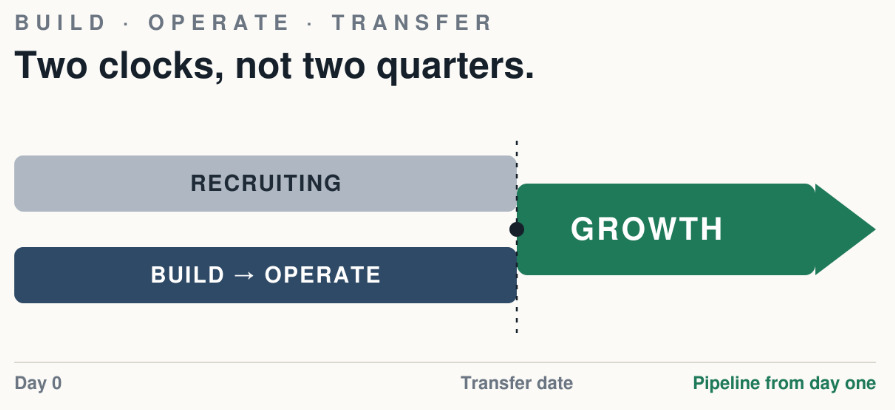
That is what build, operate, transfer does. The foundation gets stood up while you recruit, on a parallel track, so the two clocks run at once instead of back to back. The system is operated until it is genuinely producing, not until a deck says it should be. Real campaigns, real routing, real pipeline, proven against your numbers. By the time your hire signs, the growth machine is already running.
That collapses time to pipeline from two or three quarters down to roughly day one. And it costs less, because you are not paying a senior full-time salary to do months of setup, and you are not financing a ramp before anything produces.
The leverage is in the overlap. A transfer is not a template dropped on your doorstep. The build runs alongside your new hire at handoff, tuned to your business: your ICP, your sales motion, the way your buyers actually move. They do not inherit a generic engine to reverse-engineer. They inherit a working system already optimized for you, with the reasoning behind every decision handed over alongside the system itself. The artifact transfers, and so does the thinking.
Then it transfers out, on a fixed date agreed up front, and that is the part that protects the leader buying it. A function builder who stays indefinitely is structurally motivated to keep you dependent, because the longer the engagement runs the more it bills. A transfer date inverts that incentive completely. When the deal is build it, prove it, and hand it over on a date, the build only succeeds if the team can run it without help. The exit is not the catch. The exit is the proof.
That is the model end to end, and it is the bridge between bare-bones, founder-led marketing and an actual growth machine: built while you hire the people who will own it, optimized for your business at the handoff, and transferred the moment it works.
The tell, one more time
The companies that win at demand gen did not hire better people. They started their hire on running ground instead of bare ground.
So before you approve that growth marketing req, read it the way your candidate will read it in month three. If it says build and run, you are asking someone to architect a house while they sell it. People survive that. It just costs you two quarters, and often the person.
One question to sit with. If your demand gen hire started Monday, would they spend their first two weeks building the system or running it? If the honest answer is building, there is a faster way to the same place, and it starts before the offer ever goes out.